

Healthcare jobs continue to grow

As Healthcare jobs continue to grow
A closer look for Nurses
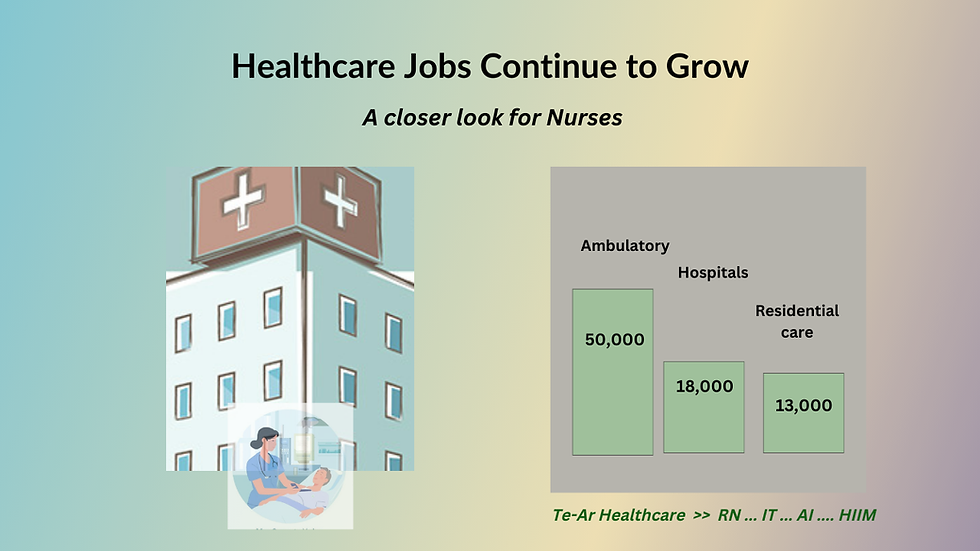
The Bureau of Labor Statistics has released jobs data for January 2026. Healthcare continues to grow, adding 82,000 jobs in January alone.
While healthcare employment continues to expand, policies that impact nursing education financing are moving in the opposite direction. At a time when workforce demand is accelerating, limiting financial pathways into advanced nursing roles sends a contradictory message.
The breakdown:
📈 50,000 in Ambulatory health care services
📈 18,000 in Hospitals
📈 13,000 in Nursing and residential care facilities
Yes, the healthcare economy is a “big deal” in the overall U.S. economy. Growth in the healthcare sector has increased and has been "quietly" increasing over the past decade.
Can we conclude?
The healthcare workforce has become the backbone of the labor market -- attracting and keeping a workforce is mission critical for hospitals, health delivery, consumers, public safety and, all of life.
Where do these statistics leave the Nursing workforce which has a huge shortage throughout the healthcare sector? The data tells us jobs are moving from inpatient, hospital roles to outpatient, ambulatory roles. This leaves a critical shortage for inpatient care.
The Real Reason:
One study of RNs (noted in JAMA Network, Vol .9, No.2) who recently left a hospital staff nurse job, indicated they would return to the hospital workforce if hospitals were willing to address organizational issues driving RNs away. The top factors to increase their likelihood of returning were 1) adequate staffing, 2) flexible scheduling, and 3) better wages or benefits. It is noteworthy that some “nonretired” RNs, particularly those not currently employed, reported they would be willing to return to work if conditions are met. Trained, licensed and prepared Nurses returning to the workforce would have a meaningful effect for staffing ratios.
The Nursing retention problem (crisis) will not be solved by educating and training more Nurses. Thus, “all the more” reason to respond to Nurses’ requests, include them in executive decisions and treat with respect. Training more nurses into a system that is pushing experienced nurses out is fiscally inefficient and clinically unsafe. Retention must be treated as workforce infrastructure.
Reclassifying Nurses creates many problems:
The recent decision from the U.S. Department of Education (ED) to reclassified Nursing outside of the definition of the “professional degree” loan category will, long-term, continue to hinder graduate-level nursing program candidates. Not including nursing as a professional degree is yet another barrier to nursing education.
At the same time healthcare employment continues to expand, federal education policy is moving in the opposite direction. As discussed in my previous analysis of the Department of Education’s reclassification of nursing degrees, this decision directly impacts graduate-level borrowing limits and long-term workforce development.
The Facts:
👩⚕️ Healthcare is growing (BLS data).
👩⚕️ Nursing shortages persist due to retention issues.
👩⚕️ Advanced practice nurses are essential to ambulatory growth.
👩⚕️ Graduate nursing education just became financially more restrictive.
👩⚕️ That misalignment creates long-term system risk.
The question is not whether healthcare will continue to grow — the data clearly shows that it will. The question is whether policy decisions today will support or constrain the nursing workforce needed to provide care throughout the continuum of care.
I’m available: https://www.te-ar.com/aboutme
RN☤🎓 🎩 🍽️ 🧑⚕️💗🌍 🎓 🎩 RN☤ 🍽️ 💗🌍 🎓 🎩 🧑⚕️🍽️ 💗🌍RN☤
Connect on LinkedIn for ongoing conversations >>>>


Comments